
 Series of furniture for staff
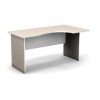 Office desks
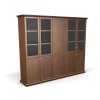 Office cabinets
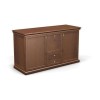 Office pedestal
 Office partitions
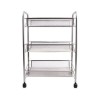 Office Accessories
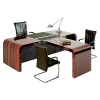 Series of offices for the head
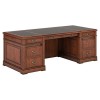 Executive desks
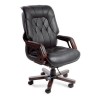 Executive chairs
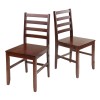 Wooden chairs
 Staff chairs
 Office chairs
 Computer chairs
 Bar and pab chairs
 Soft chairs
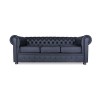 Office sofas
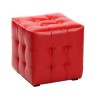 Poufs and banquettes
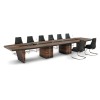 The negotiation area
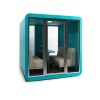 Acoustic cabins
 A series of furniture for the reception area
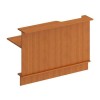 Straight reception desks
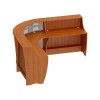 Corner reception desks
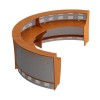 Round reception desks
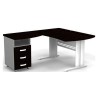 Corner office desks
 Tables for staff
 Writing desks
 Computer desks
 Dining tables
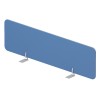 Desktop Office Partitions
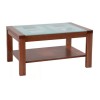 Coffee tables
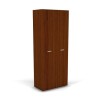 Office wardrobes for clothes
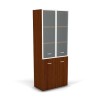 Office filing cabinets
 Archive cabinets
 Loft racks
 Office shelving
 Marker boards
 Footrests
 Office Hangers
 Benches
 Bookcases and shelves
 Storage & Organization
Why do we need requirements for furniture arrangement?
First and foremost, the executive manager should think about a comfortable and healthy environment for every employee. Firstly, it suggests high quality furniture, and secondly, a spacious office. Besides that, accessibility, mobility and convenience, i.e. ergonomics, can be also suggested here. All these are pivotal to ensure high performance directed towards achieving the company’s goals. Or benefit, in other words.
That is why the more employees are at ease, the more efficient they are throughout the whole working day. This has a direct impact not only on their income but on the income of their top management. Thus, it should be in the latter’s best interest to be caring and attentive to space planning and create an ideal environment for efficient work.
A worker can address the responsible authority to resolve the situation and keep their position in case their top management does not provide them with proper equipment, facility, and furniture, or the following regulations are violated:
- sanitary,
- organizational,
- technical,
- ergonomic,
- hygienic,
- economic.
Which authorities regulate the proper furniture plan in the office?
These are not just imaginary rules which are handed over from one executive to another, but these are the rules which are regulated by Labor Law and sanitary rules and codes. Apart from the enumerated legislative acts, the regulations can also be regulated by international standards and agreements between an ordinary employee and an employer.
Conventionally, the requirements are divided into several groups:
- Requirements for the arrangement of furniture and equipment in the office;
- Requirements for lighting, noise and vibration levels in the room. This also includes the microclimate (heating, placement and number of windows).
Legal documents that regulate the requirements for the arrangement of a workspace
The correct arrangement of the furniture
One of the main documents with requirements is Occupational Safety and Health Administration (OSHA) standards that encompass sanitation and hygiene practices to protect workers' health. The main idea is to create a workplace that will comply with sanitary standards. These standards are mandatory for all legal entities, as well as individual entrepreneurs.
The size of the working area for one employee
- The size of the entire area for one person should not be less than 48 ft², and should exceed 60.8 ft² for physically challenged workers. If there is a wheelchair, the area expands up to 82 ft².
- The distance between neighboring work surfaces should be about 10-13 feet. Talking about computers, the distance between them should not be less than 4 feet. When planning an Open Space type of office where a big table is supposed to serve several workers at a time, working zones should be separated from one another with partitions that should be about 5-6.5 feet tall.
- Work desks should be positioned so that light falls on them from the left.
- If there is a printer, scanner or other office equipment on the desk (in addition to the computer), the surface area should be extended.
- In addition to providing sufficient space and necessary furniture, the executive manager is obliged to provide their workers with the possibility of changing their position from “sitting” to “standing”, and vice versa according to state standards.
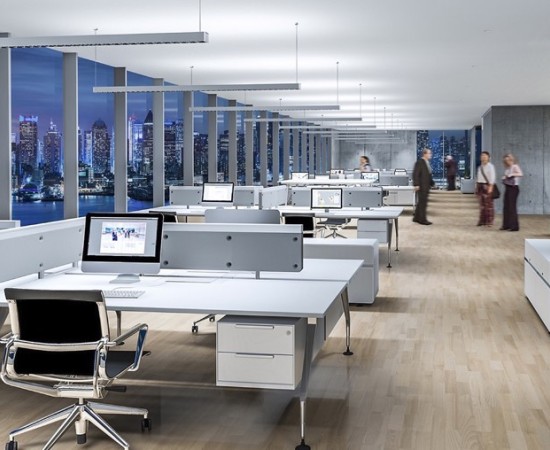
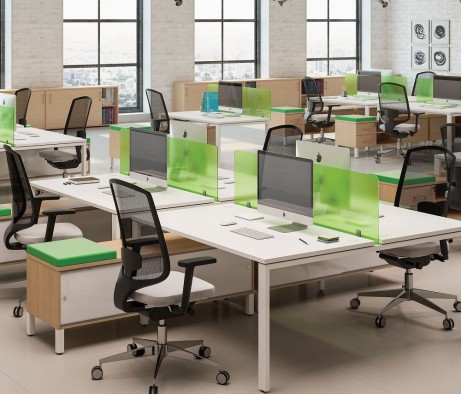
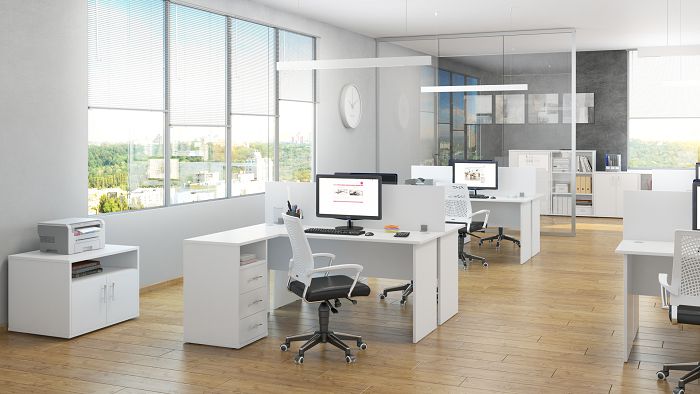
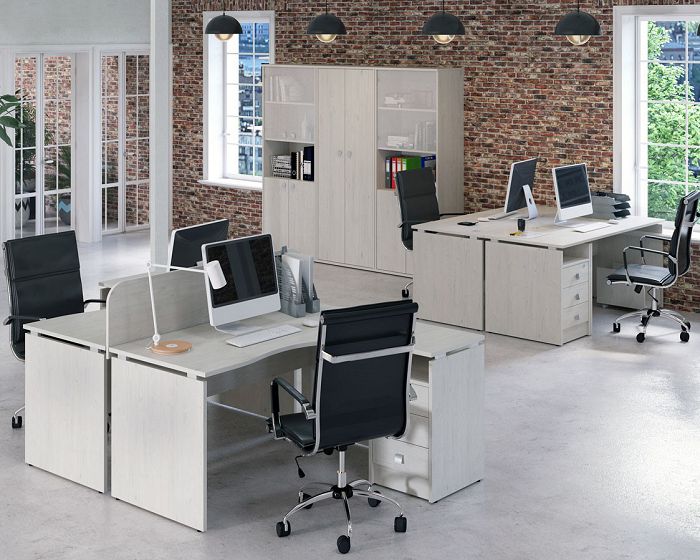
The photo below illustrates a really good example of furniture arrangement that aligns with all requirements:
Computer
- It is prohibited to arrange desks in such a way that computer displays face each other.
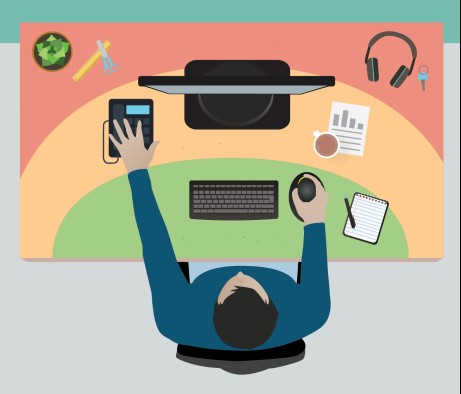
- The height of the desk should be selected individually for the employee so that their eyes look directly at the monitor from a distance of up to 2.3 feet.
Office chair
- The height of the chair is also selected individually. This is influenced by the employee’s height and time they spend at work.
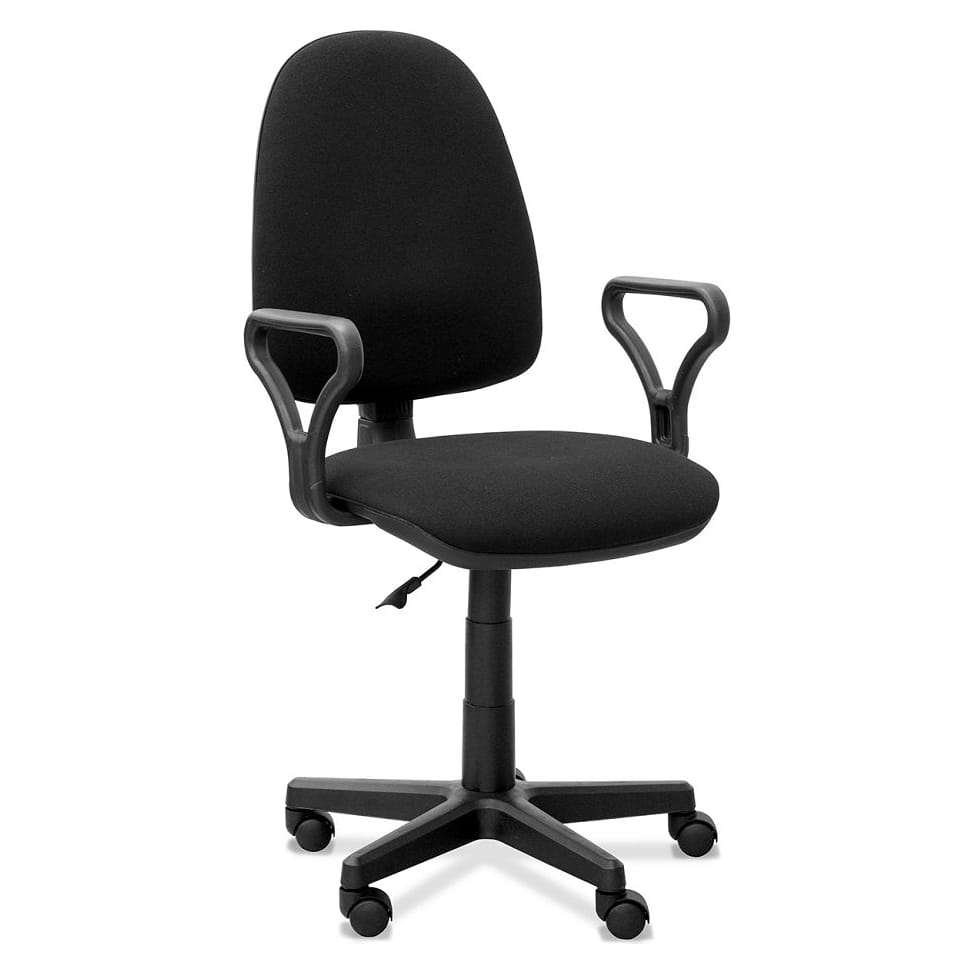
- Chief health inspector says that chairs should:
- have a breathable cover;
- have a non-slip cover;
- have height and angle adjusting mechanisms.
The photo below shows the appropriate office chair::
Additional recommendations when planning an office and arranging furniture
There are some points which are not mentioned in the documents, but they can give an office a makeover in terms of ergonomics, and aesthetics.
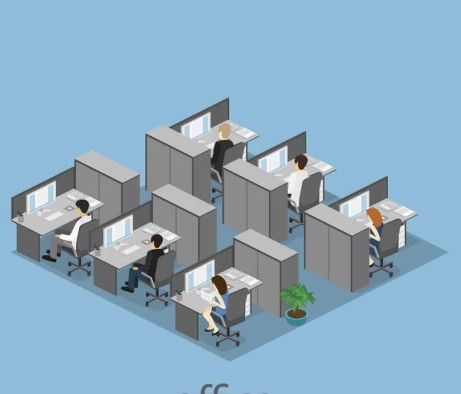
- Employees should not sit face-to-face at their desks by using partitions.
- It is not advisable to position employees with their backs to the aisle or entrance. It will be much smarter to place them diagonally.
- Chairs for visitors look better beside desks rather than in front of them.
Microclimate, noise proofing, and lighting
The requirements for the microclimate, lighting and noise levels are regulated by OSHA, Centers for Disease Control and Prevention (CDC), and Environmental Protection Agency (EPA) standards.
Lighting
Any space where a worker spends more than two hours should be equipped with natural lighting as well as artificial.
The brightness range of the artificial lighting depends on the type of premises:
- Workplace - from 28 to 46.5 fc;
- Open Space - up to 37 fc;
- Staircases and halls - up to 9 fc.
It is prohibited to locate the source of light behind one’s back or above their head. It does not provide enough light, and makes the work more challenging.
Noise
According to the requirements, the standard noise level is 80 dB. If it is an office space, it must not be located near factories or workshops.
Microclimate
This is also a very essential point, as temperature and humidity affect workers’ performance.
- In summer it is recommended to maintain the temperature at 77°F, and 75.2° in winter. There can be some deviations within a few degrees.
- Humidity should not exceed 60% at any time of the year.
Requirements for the dining area
The Food and Drug Administration (FDA) regulates food safety and sanitation for dining areas.
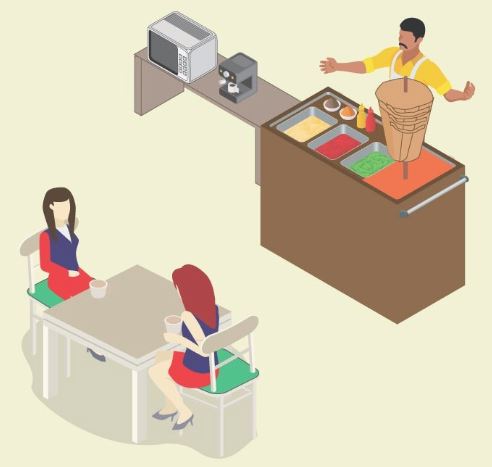
- The minimum size of a dining area can be 64.5 ft² under the condition that there are maximum 10 people at the same time.
- If there are more than 20 employees in the company, the dining area should be at least doubled accordingly.
- If there are more than 30 employees, the company is obliged to provide them with a full-size cafeteria.
A mandatory condition for any room intended for having meals is the presence of a dining table, a sufficient number of chairs, a fridge, a microwave oven, and a sink.
Provision of security
There are also the following standards:
- NFPA 101: Life Safety Code;
- NFPA 70: National Electrical Code.
They are aimed at ensuring the safe functioning of the employee in the office. For this reason, the requirements regulate:
- Finishing materials;
- Electrical equipment;
- Availability of fire protection systems and equipment;
- Availability of alarms;
- Emergency exits;
- Evacuation route plans.
If the manager chooses to neglect and disregard the rules, especially fire safety ones, legal actions will be taken against them, e.g. they will be fined. In other cases, higher authorities may suspend the organization's activities for a period of 1 to 3 months.
Passage width in the office
A significant point that is very important to pay attention to in the first place since these requirements are related to fire safety instructions.
Recommended parameters:
- For 1 employee in the office, the passage width is 2 feet.
- For 2 employees in the office, the passage width is 2.5 feet.
- For 3 employees in the office, the passage width is 3 feet.
- The distance between the wall and the work area should be at least 2 feet.
- The distance between respective work surfaces should start from 1.8 feet.
- The distance between desks that stand behind other desks is 2.3 feet.
- The distance between a cabinet or pedestal and the work area starts from 6 feet.
Simply put, aisles should take up to 20% of a room-type office area and up to 15% of the Open Space type area.
Violations that you can correct
There are moments that can be corrected before you are fined. You just need to do them in time.
- Calculate the number of workers and the size of the whole facility. Try to allocate enough space for every employee (from 49.5 to 65.5 ft²).
- Measure the interior temperature. Install air conditioners or additional heaters if ordinary radiators are not enough.
- Equip your office space with extra sources of light.
- Do not forget about the reception zone, dining area, storage room (if present), and bathroom. The latter should specifically maintain all sanitary standards.
Advice: In order to make your office more ergonomic, think about the furniture in advance. It should be made of a high-quality material complying with all requirements. Moreover, there should be adequate furniture in the room.
Take a closer look at modern solutions, including partitions, and at mobile desks with wheels. You can also buy a multifunctional module. Firstly, it is convenient and practical, and secondly, it will help you resolve the space issue when providing your employees with sufficient working space. Using such modules, you can always adjust the size of the working area adding ports to the already existing module.
A helping hand for an executive
Yes, we understand that there are tons of requirements for workspace arrangement. In order to save you time and money you can ask designers for help to design your future office.
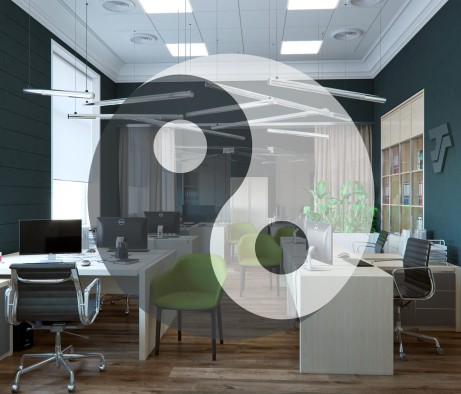
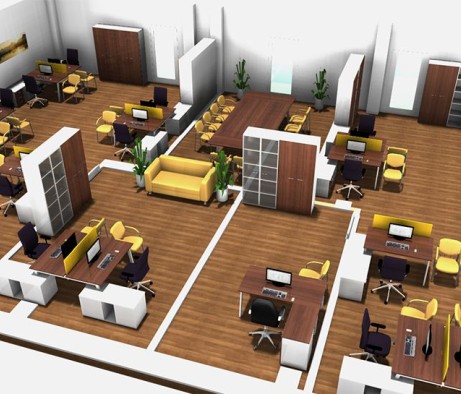
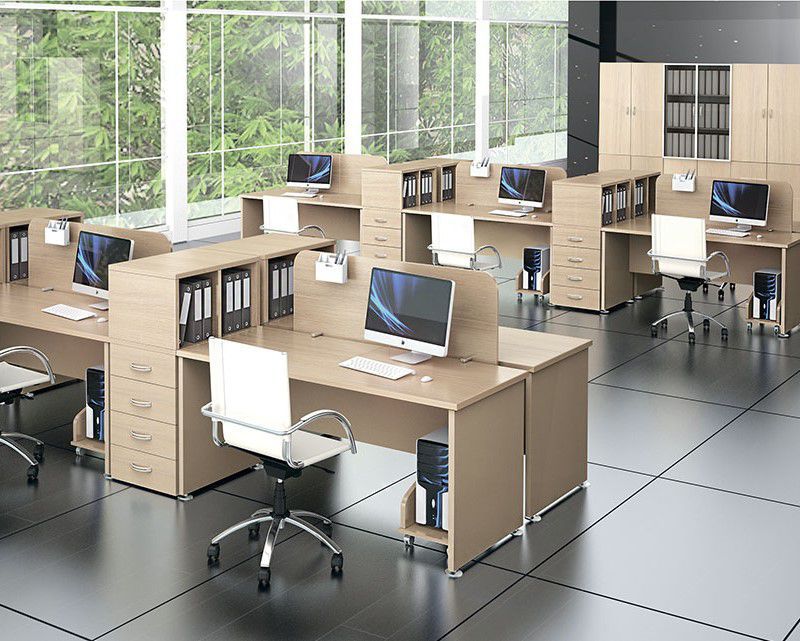
The photo below illustrates an example of a ready-made modern ergonomic office:
The specialists will approach your case with high professionalism. They will:
- carefully study the architecture of the premises, its cadastral passport;
- select materials and coatings that will meet all requirements;
- think about the best way of placing and arranging furniture in your office.
As a result, you will get a completed interior design.
If you realize that you are not ready to spend money on the services of qualified specialists, try to study all the regulations connected with your type of premises really thoroughly.
Conclusion
The requirements that are regulated by the relevant authorities for the arrangement of furniture are an important aspect of ensuring the safety and comfort of your subordinates. Thus, an executive manager faces the task of arranging the working space so that it aligns with all requirements. The successful completion of their objective will influence several factors. Firstly, an efficient worker can expect a promotion in the company, and secondly, their high-performance leads to high benefits or income (theirs and their company’s).
That is why both parties should be interested in the clever arrangement of the working space as it is vital for employees’ comfort, and essential for the growth of the employer’s income.